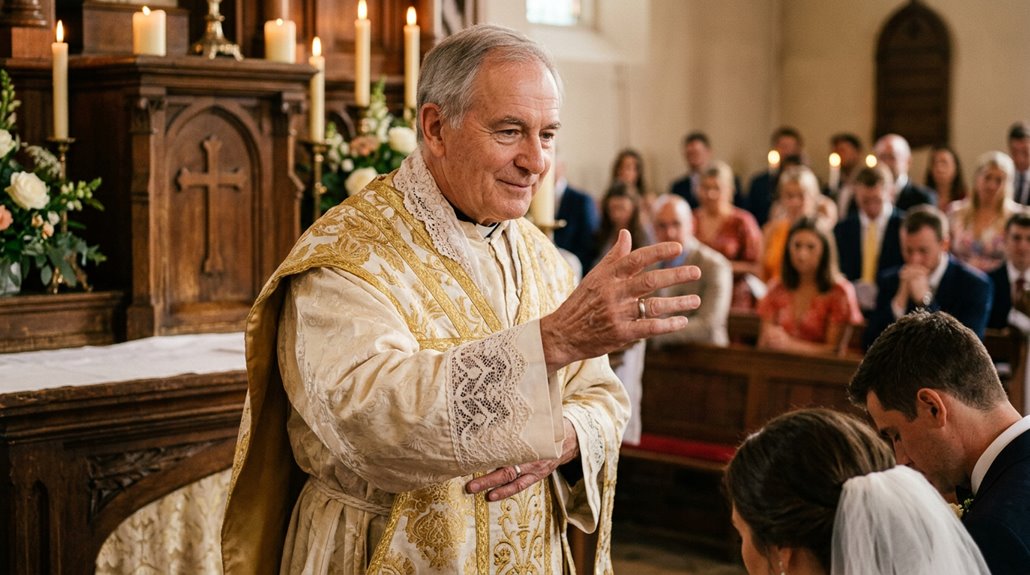
At Catholic weddings, priests guide couples through sacred words that transform personal promises into sacrament. They ask pre-consent questions confirming voluntary entry and openness to children, then witness the couple’s affirmative responses. The priest blesses rings, invokes God’s grace through the nuptial blessing, and pronounces the couple married. Throughout, language emphasizes lifelong fidelity, mutual support, and covenant commitment. These carefully chosen words, from consent formulas to pronouncement declarations, establish the spiritual foundation of the marriage bond before God and the Church community.
What Makes a Catholic Wedding a Sacrament
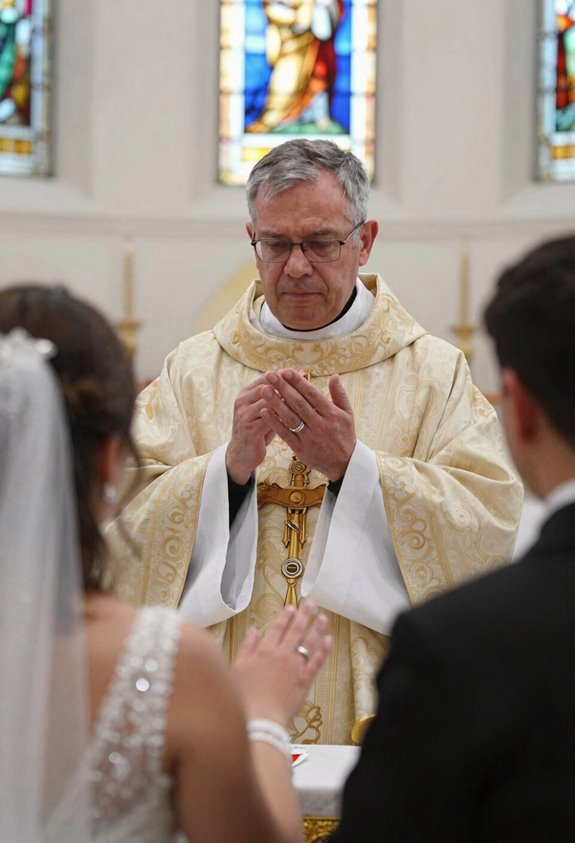
How do two people transform a wedding ceremony into a sacred sacrament in the Catholic tradition? The answer lies in consent. When you exchange vows before the priest and gathered community, you’re not simply expressing personal promises. You’re creating a sacrament, a sacred sign through which God’s grace flows into your marriage covenant.
The sacrament becomes official through your freely given consent, expressed after the priest poses three essential questions. These questions confirm you’re entering marriage willingly, committing wholeheartedly, and remaining open to children. Your affirmative responses, typically “I do,” constitute the act of consent that forms the sacramental foundation.
This consent, witnessed by the Church and celebrated within the liturgical context, transforms your wedding into something transcendent. You’re not just getting married; you’re embarking on a lifelong covenant blessed by God’s presence.

English Wedding Arras Coins Set: Includes 13 English blessing coins for a Catholic or Cristiana wedding ceremony, supporting the traditional arras de matrimonio exchange.

【Elegant Wedding Vow Books】The “her vows” book comes in a white cover with pressed gold foil accent and the “his vows” book comes in a black cover with pressed gold foil accent. The pressed gold lettering foil accents gives the vow journal an elegant and classic look that is perfect for a wedding day.

The Ceremony Structure: What You’ll See and Hear
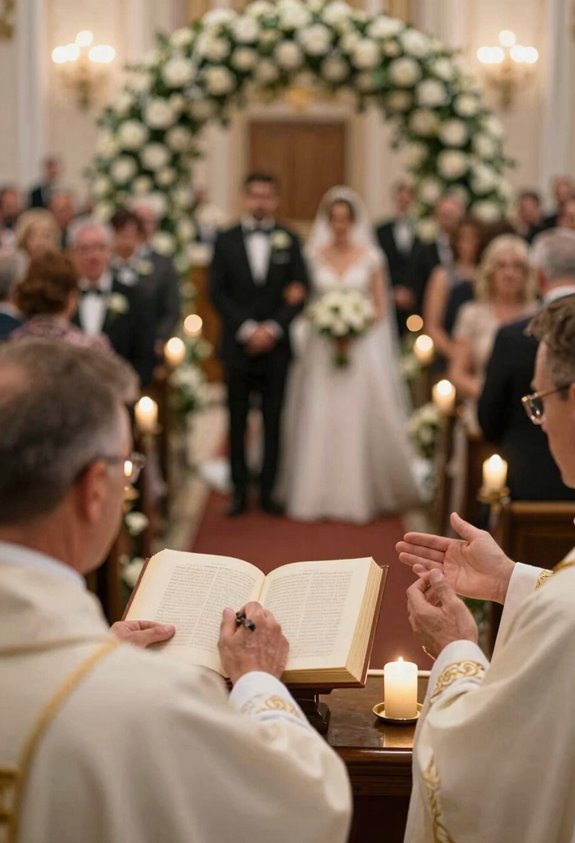
A Catholic wedding ceremony unfolds in a carefully ordered sequence designed to honor both the couple’s consent and the Church’s liturgical traditions. The priest opens with a welcoming address and blessing, establishing the sacred atmosphere. A reading follows, often accompanied by remarks about the couple’s journey together. The exchange of words of consent represents the marriage’s legal and spiritual foundation, where you’ll hear each partner affirm their commitment. Vows and ring exchanges deepen this promise. The nuptial blessing invokes God’s grace upon the union. If the ceremony occurs within Mass, the Liturgy of the Eucharist proceeds; outside Mass, the service concludes after the blessing. The priest pronounces the marriage official, the couple shares a kiss, and a recessional follows, sometimes including reception logistics or announcements.

6 Pack Saint Michael the Archangel White Religious Candles - Bundle with 8" Michael the Archangel Candles for Vigils, Prayers, Blessing Ceremonies, More | Devotional Candles in Glass.

Supports mexican artisans and helps preserve traditional crafts, and boosts the local economy.

6 Pack Sacred Heart of Jesus White Religious Candles - Bundle with 8" Corazon De Jesus Glass Devotional Candles for Vigils, Prayers, Blessing Ceremonies, More.
Scripture and Readings: Why They’re Chosen
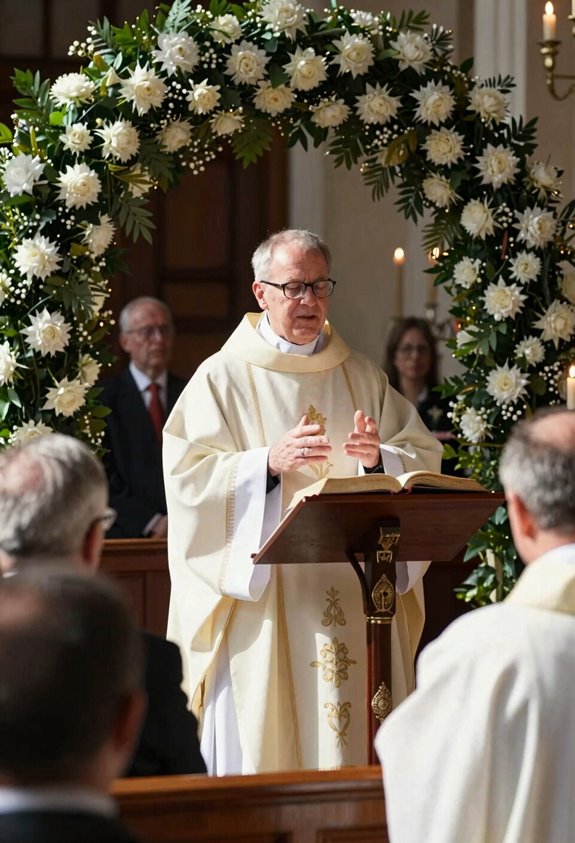
After the priest establishes the ceremony’s sacred tone through his opening remarks and blessing, the service incorporates carefully selected readings that deepen the spiritual meaning of the union.
Priests choose readings that emphasize love, covenant, and faith, drawing from scripture passages like 1 Corinthians 13 to set an uplifting atmosphere. These readings are purposefully aligned with your wedding’s spiritual theme and the couple’s journey together.
The readings you’ll hear serve specific functions:
- Complement vows and prayers rather than replace them
- Remain accessible to all congregation members regardless of faith background
- Provide moments for reflection, often followed by responsorial elements or priestly context
Delivery depends on parish preferences and liturgical norms. The priest, a guest, or the couple themselves may present the readings, ensuring they resonate meaningfully throughout the ceremony.


Questions Before Consent: What Priests Ask
Before you exchange vows, the priest poses three essential questions that form the explicit moment of consent within Catholic nuptial rites. These pre-consent questions, outlined in The Order of Celebrating Matrimony #60, ensure you’re entering marriage freely, wholeheartedly, and with openness to children.
| Question Focus | Your Response | Meaning |
|---|---|---|
| Freedom | “I have” | You choose marriage willingly |
| Sincerity | “I am” | Your commitment is genuine |
| Permanence | “I do” | You intend lasting union |
You’ll typically respond with “I have” or “I am,” signaling clear personal consent. Memorizing these responses helps you maintain focus on the deeper meaning during the ceremony. These questions precede your vows and the Blessing and Giving of Rings, establishing your mutual commitment before witnesses and God.


This gorgeous stunning tungsten ring is excellent possession for men and women, which always pursuit perfection

Consent as a Sacred Covenant: The Core Promise
What makes a Catholic marriage valid? Your consent, the freely given commitment you make before God and the Church. This sacred covenant forms the essential foundation of Catholic matrimony, transforming your personal promises into an unbreakable bond.
The consent you exchange represents three crucial commitments:
- Lifetime fidelity – You pledge to remain together through good times and challenging seasons, sickness and health, embodying the promise “until death do us part”
- Mutual acceptance – You declare your acceptance of each other as spouse, using formulas like “I take you to be my husband/wife”
- Forward-looking promise – Your consent encompasses the entire future, establishing an enduring covenant rooted in present intention
These words of consent, spoken during the Nuptial Mass or Catholic wedding rite, constitute the essential act establishing your marriage before witnesses and God.

【A5 NOTEBOOK WITH PEN】Package comes with an A5 lined journal and a premium metal pen. The notebook journal has a metal buckle to helps keep it securely closed. Decorated with gold inscription "officiant", this wedding officiant book presents a refine and sophisticated look. Great leather notebook and pen combo, perfect gift for officiant to use while hosting weddings or taking notes.


Four Consent Formulas: What Couples Say
How do you actually say your vows in a Catholic wedding? The Church provides four consent formulas that couples can choose from, each offering a slightly different structure while maintaining the same sacred commitment.
The first formula begins with “I, name, take you, name, to be my wife/husband,” followed by fidelity promises. The second incorporates “to have and to hold, from this day forward,” language familiar to many couples. A third option uses a question-and-answer format where you respond “I do” to the priest’s prompts. The fourth presents an alternate question-and-answer structure, also concluding with “I do.”
These consent formulas originate from The Order of Celebrating Matrimony and work within any wedding context. Many couples memorize their vows beforehand to ensure focused delivery of this central promise.

100% Customer Satisfaction Guarantee

Full Orthodox Catholic gift set: Includes holy water, anointing oil, sacred soil, incense, candle, icon, wood cross & certificate

Package Includes: 1 faith holy spirit confirmation candle; These holy spirit religious baptism candles have significant commemorative value and are suitable for confirmation, mass, baptism, and Catholic ceremonies
The Vows Explained: Sample Language and Meaning
The vows you exchange form the sacramental heart of Catholic marriage, constituting your mutual consent and establishing the covenant binding you together. These declarations traditionally employ covenant language emphasizing lifelong commitment: “I take you to be my wife/husband, to have and to hold, in sickness and in health, all the days of my life.” This language anchors the promise in both spiritual and practical realities. By speaking these approved formularies, you perform the essential declaration of consent that the Church recognizes as creating the bond of matrimony itself.

Bountiful Package: each set comes with 100 Bible bookmarks, each carrying a unique, meaningful Bible emergency number for various life situations; Ideal for individual use, these bookmarks bulk package is also ideal for Father's Day, Mother's Day, Easter, Christmas, and Thanksgiving gifts


The Essential Declaration Of Consent
At the core of every Catholic wedding ceremony sits a singular, irreplaceable moment: when both partners freely express their consent to marry one another.
This essential declaration of consent is not merely ceremonial. It is the foundational act that establishes the marriage itself. Before you speak your vows, the priest poses pre-consent questions confirming three critical elements:
- You enter freely, without coercion or pressure
- You commit wholeheartedly to this lifelong union
- You remain open to children within the marriage
Your consent follows these questions, typically using traditional language such as “I take you to be my spouse, to have and to hold from this day forward, until death do us part.” Some ceremonies employ responsive “I do” formats instead. This moment, spoken before God and your community, transforms the vows into a binding covenant.
Covenant Language And Lifelong Commitment
Within the Catholic wedding ceremony, the vows you exchange represent far more than poetic promises. They constitute the actual covenant that establishes your marriage before God and the Church. Your consent and vows create an unbreakable bond extending beyond the present moment into your shared future together.
| Vow Component | Meaning | Example Language | Significance |
|---|---|---|---|
| Mutual Promise | Reciprocal commitment | “I take you as my spouse” | Establishes equality in covenant |
| Lifelong Fidelity | Permanent bond | “All the days of my life” | Affirms permanence before witnesses |
| Shared Life | Complete union | “In sickness and in health” | Encompasses all life circumstances |
| Divine Presence | Sacred witness | Spoken before God and Church | Transcends personal commitment |
These vows embody consent freely given, wholehearted dedication, and openness to children. Whether using traditional language or local alternatives, your vows transform personal promises into sacramental reality, binding you eternally.
The Nuptial Blessing: Grace for the Marriage
After you exchange vows and rings, the priest invokes the Nuptial Blessing to ask God’s grace upon your marriage, emphasizing fidelity, mutual support, and the sanctification you’ll experience together. This blessing draws from approved liturgical texts, which may be adapted slightly depending on your parish’s rite and traditions. You’ll encounter this moment strategically placed within the ceremony sequence, typically after your personal promises but before the final rituals. The priest’s words consecrate the commitment you’ve just made.


Complete Arras Wedding Coins Set:Our arras de boda cristiana is an essential part of a traditional Catholic wedding ceremony. It includes 13 silver-plated unity arras coins, a silver coin tray, a beautifully crafted case, and a silver heart-shaped accessory. This complete set provides everything needed for a meaningful and seamless unity ceremony, celebrating tradition with elegance and charm.

STAINLESS STEEL DURABILITY: This ring is crafted from high-quality stainless steel, known for its exceptional durability and resistance to tarnish, corrosion, and scratches. It is designed to withstand everyday wear and maintain its polished appearance for years to come.
Purpose And Spiritual Significance
Following the exchange of vows and rings, the priest delivers the Nuptial Blessing, a sacred invocation that seeks God’s grace for the couple’s married life. This blessing carries deep spiritual significance, grounding your union within your faith community.
The Nuptial Blessing serves three essential purposes:
- Requesting Divine Grace — The priest petitions God to bless your marriage with strength, wisdom, and spiritual guidance throughout your journey together.
- Emphasizing Covenant Responsibilities — The blessing reinforces your mutual obligations of fidelity, support, and growth in love before God and witnesses.
- Guiding Toward Holiness — Through scriptural references and theological language, the blessing directs you toward sanctification and fruitful family life.
The priest often personalizes this blessing, reflecting your unique vows and circumstances while anchoring your commitment within Catholic tradition and doctrine.
Traditional Blessing Formulas And Text
What exactly does a priest recite when delivering the Nuptial Blessing? The Nuptial Blessing draws from Traditional Catholic liturgy and ICEL translations, invoking God’s grace upon your marriage. This formal rite typically follows your exchange of vows and rings, whether within Mass or as a separate ceremony.
The blessing’s text petitions for your shared faith, family growth, and mutual support through life’s challenges. Priests guide this sacred moment, often preceded by the Questions Before Consent and declarations of intent, depending on local rite usage.
Variations exist across different circumstances: within Mass, without Mass, or between Catholic and non-Catholic participants. Your local parish may incorporate additional blessings or prayers reflecting community customs, creating a personalized spiritual experience that honors both tradition and your unique journey together.
Timing Within The Ceremony Sequence
When does the Nuptial Blessing actually occur during your wedding ceremony? The timing of this sacred moment depends on your specific liturgical format. You’ll encounter the blessing at different points in the sequence.
- During Mass: The Nuptial Blessing occurs after the exchange of vows, typically before the Eucharistic Prayer or the couple’s reception of Communion.
- Outside Mass: The blessing follows immediately after consent and vows, serving as the ceremony’s focal point without additional liturgical elements.
- With adaptations: Non-Mass ceremonies may omit or modify the blessing entirely, allowing flexibility for your unique circumstances.
The priest tailors this timing to your situation, ensuring the Nuptial Blessing maintains its powerful purpose. Knowing when this blessing occurs allows you to prepare emotionally for receiving God’s grace as you begin your marriage.
Ring Blessings and Their Symbolism
How do rings transform from simple metal bands into sacred symbols? During the ring blessing, the priest sanctifies the rings, asking God’s grace to accompany the couple’s married life. This blessing occurs after the couple exchanges consent and vows, establishing the rings as visible signs of their covenant.
The priest typically offers formal words, emphasizing that the circle represents eternity without beginning or end. This language mirrors the couple’s lifelong commitment. The rings are then exchanged, with each partner placing the blessed band on their spouse’s finger.
Some ceremonies include optional amenities like the Blessing and Giving of Arras, though the standard practice centers on these blessed rings as tangible reminders of perpetual faithfulness.


【A5 NOTEBOOK WITH PEN】Package comes with an A5 lined journal and a premium metal pen. The notebook journal has a metal buckle to helps keep it securely closed. Decorated with gold inscription "officiant", this wedding officiant book presents a refine and sophisticated look. Great leather notebook and pen combo, perfect gift for officiant to use while hosting weddings or taking notes.

The Pronouncement: Words That Make It Official
The pronouncement represents the moment when the officiant formally declares the couple married, invoking the authority vested in them by the Church, State, or both jurisdictions. The classic formula, “I now pronounce you husband and wife,” or variations that reference ecclesiastical authority, legally and sacramentally seals the marriage bond established through the couple’s exchange of consent and rings. This declaration marks the definitive transition from engaged pair to married couple, concluding the Nuptial Rite and signaling the start of their first kiss and the ceremonial presentation to guests.

100% Pure Soy for Sacred Rituals - Crafted from premium soy wax with no synthetic additives or artificial scents, our prayer candles deliver a clean, natural burn that honors...
Authority And Legal Declaration
At the culmination of vows and rings, the officiant delivers what’s known as the pronouncement, a formal declaration that transforms two individuals into a legally and spiritually married couple. This moment carries significant weight, as it represents both civil and sacramental authority.
The pronouncement typically includes these essential elements:
- A reference to the officiant’s authority, often beginning with phrases like “By the power vested in me”
- Citation of applicable jurisdiction, whether state law or church canon, establishing legal validity
- A direct statement declaring the couple married, witnessed by those assembled
This declaration marks the official transition from ceremony to celebration. Your marriage becomes official at this pronouncement, recognized by law and community through the officiant’s formal authority and legal jurisdiction.
The Pronouncement Formula Itself
Once the couple has exchanged consent and rings, the priest moves toward the actual pronouncement formula, the specific words that officially declare the marriage valid and binding. This formula represents the moment when consent transforms into sacramental reality. The priest typically invokes his delegated authority, stating something like, “By the power vested in me by the Church, I now pronounce you husband and wife.” Catholic contexts follow liturgically approved wording, ensuring consistency across parishes. The pronouncement concludes the ceremony’s essential rites, signaling that God has joined the couple before witnesses. Variations exist across denominations and local customs, yet all versions confirm that the couple’s mutual consent, now publicly declared, creates an indissoluble bond recognized spiritually and legally.
Sealing The Sacramental Bond
After the couple has exchanged vows and rings, the priest pronounces them officially married through carefully chosen words that transform their mutual consent into sacramental reality. This pronouncement carries profound significance, as it seals the sacramental bond before God and the assembled community.
The priest typically invokes canonical authority when making this declaration:
- Formal language such as “I thereby declare you husband and wife” or “The Church of God, I pronounce you married” signals the official union
- References to authority conferred by the Church establish the pronouncement’s validity and sacramental weight
- A concluding blessing or invitation for the couple’s first kiss marks the transition to their new married status
Following this pronouncement, the couple processes together as married partners, their sacramental bond now complete and publicly recognized.
Fidelity and Lifelong Love: Core Marriage Themes
How do priests communicate the permanence of marriage during the wedding ceremony? Priests emphasize fidelity and lifelong commitment through carefully chosen words that anchor the sacrament in covenant theology. The vows themselves declare promises to love and honor “in sickness and in health, until death do us part,” establishing marriage as a durable bond requiring wholehearted consent.
| Element | Purpose | Emphasis |
|---|---|---|
| Pre-vow Questions | Assess free commitment | Gravity of choice |
| Consent Formula | Formalize union | Permanent consent |
| Blessing | Invoke divine grace | Lifelong support |
| Nuptial Mass | Sanctify bond | Spiritual foundation |
The priest’s guidance reinforces that you’re entering a sacred, lifelong partnership. This language transforms wedding words into solemn promises, helping couples embark on marriage understanding its spiritual weight and enduring nature.
After the Pronouncement: What Happens Next
What follows the priest’s formal declaration marks the ceremonial turning point, transforming two individuals into a married couple in the eyes of the Church and assembled guests. The pronouncement initiates several meaningful moments that solidify your newly married status:
- The Kiss and Blessing – You may share your first kiss as spouses, after which the officiant completes the formal declaration before your community.
- The Presentation – The priest announces you as newlyweds, inviting guests to celebrate this significant transition into married life together.
- The Recessional – You exit while the wedding party follows in reverse order of arrival, with music accompanying your departure.
The officiant may also remind guests about upcoming amenities like cocktail hour, connecting the ceremony to celebrations ahead.