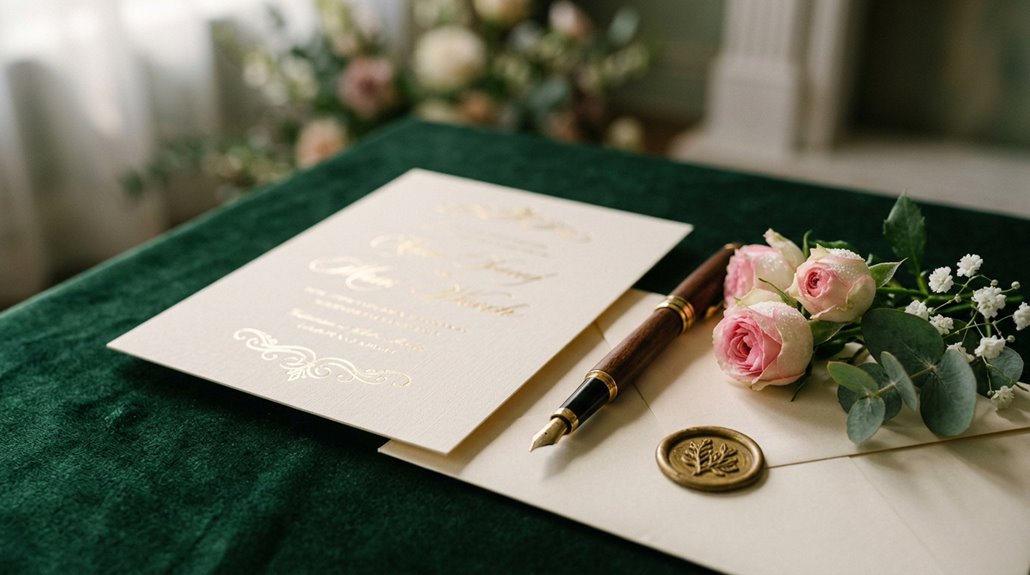
Your wedding invitation communicates essential details: host line, couple names, date, time, venue address, reception logistics, dress code, and RSVP information.
Start with who’s hosting and paying, then feature the couple’s full names prominently.
Write out date and time formally to match your event’s tone.
Include complete venue addresses for both ceremony and reception if separate.
Specify dress code clearly using terms like “Black Tie” or “Cocktail Attire.”
State your RSVP deadline and response method explicitly.
These elements prevent guest confusion and establish your celebration’s appropriate tone.
Start With the Host Line: Whose Names Come First?
Start With the Host Line: Whose Names Come First?
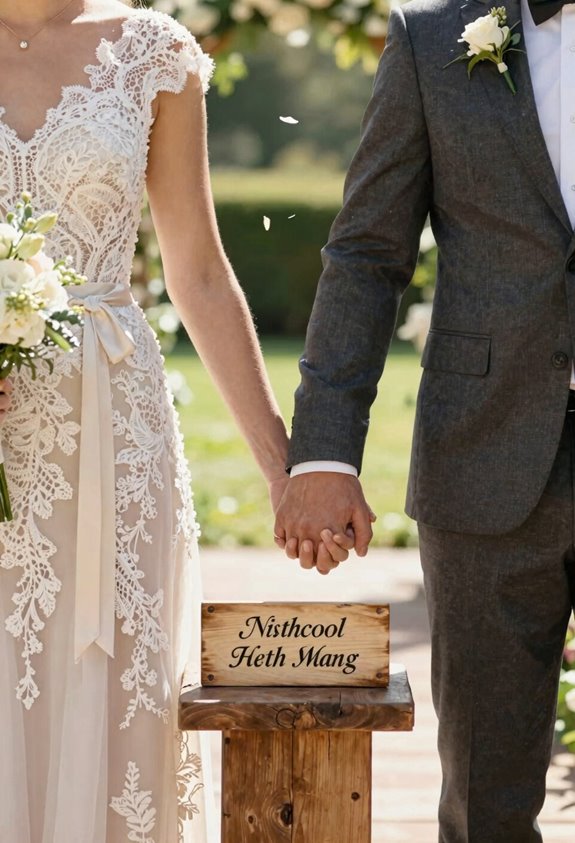
The host line represents the opening declaration of your wedding invitation. This line identifies who’s hosting and paying for your wedding, whether that’s the bride’s parents, groom’s parents, both families, or you as a couple. Traditional wedding invitation etiquette places the bride’s name first on the host line, reflecting established conventions. Modern wording often embraces flexibility, using combined phrases like “Together with their families” or “The honor of your presence at the marriage of.”
Your hosting responsibility determines the formal invitation wording you’ll select. When parents’ names appear, consider their marital status carefully. The host line sets your invitation’s tone and formality level, which guides language choices throughout your stationery design.
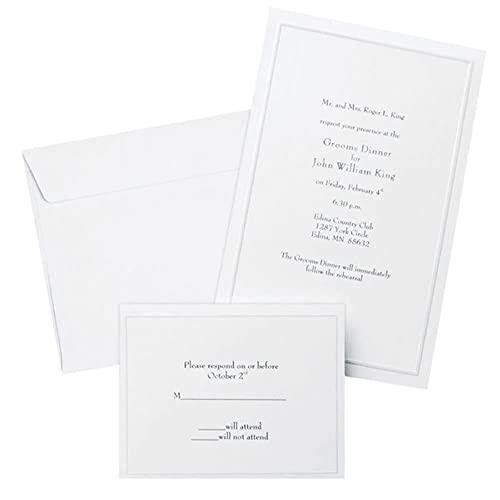
Give your special day the significance it deserves with the classic and pristine design of our convenient print at home invitations and response cards

These pre-folded silver vellum wraps are designed to fit a 5" x 7" wedding invitation and corresponding insert cards. Vellum jackets measure 5.08in wide by 7.08in high when folded, so make sure your invitation is 5 x 7 inch.

【What's Included】: A bulk quantity of 50 pieces burgundy printed floral vellum jackets
Name the Couple: Order, Full Names, and Formality
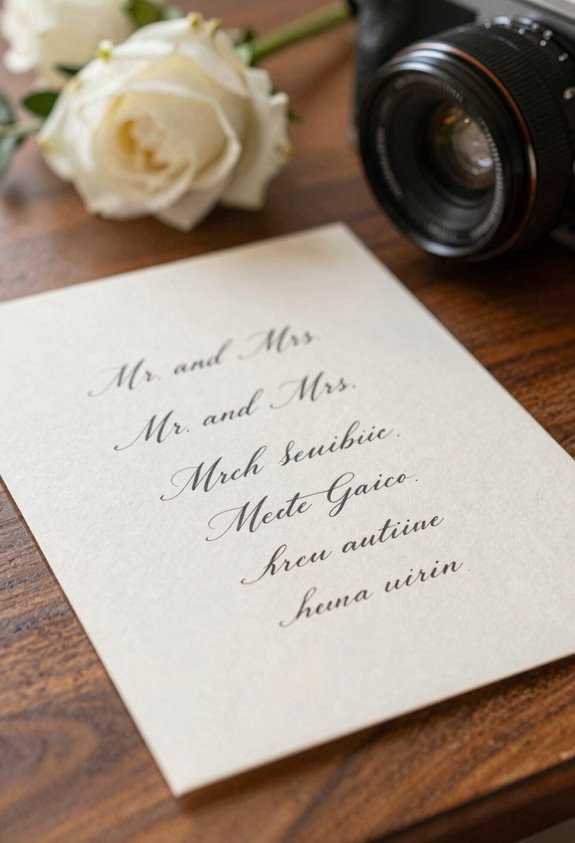
Once you’ve established your host line, your invitation’s focal point becomes the couple’s names themselves. Traditional invitation wording places the bride’s full names first, followed by the groom’s full names, establishing clear couple names hierarchy. Modern approaches, however, may vary this order alphabetically or by personal preference, reflecting contemporary sensibilities.
Your couple names warrant larger, more prominent typeface to distinguish them from host lines and surrounding details. Maintain formality consistency by using full names, including middle names or initials when appropriate. Match title usage across your invitation, whether you employ “Mr.” and “Ms.” or omit titles entirely.
Host lines can influence how couple names appear. The core names remain your invitation’s central element. This deliberate presentation ensures guests immediately recognize whom they’re celebrating.

Full Set: 50 Pack of RSVP Postcards for wedding favors, receptions, parties, events, and celebrations.

50 RSVP Online - Website Details Cards - Invitation inserts for special events & weddings

Greenery Wedding Invitation Set: Our wedding invitations with rsvp cards are perfect for creating unforgettable save the date invitations for weddings. Ideal for any invitation for wedding and wedding reception invitations
Write Your Date and Time Wording
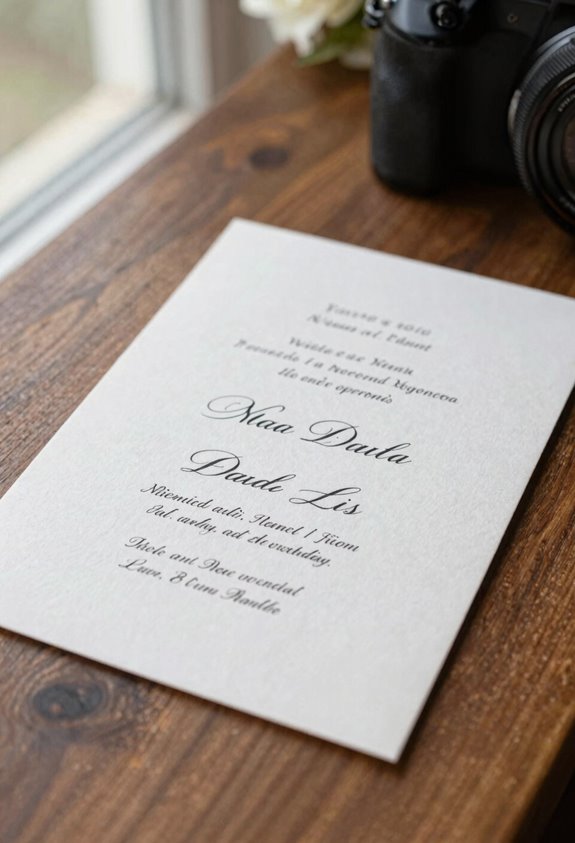
You’ll want to select a time format that matches your invitation’s formality level, whether that’s the spelled-out elegance of “Five O’Clock in the Evening” or the modern clarity of “5:00 p.m.” Consider your cultural traditions, seasonal daylight, and guest convenience when choosing your ceremony time, then maintain consistent formatting throughout all invitation details. Reception timing, location changes, and any program notes deserve their own clear lines so guests understand the complete event schedule from start to finish.

Size: Our wedding invitation cards are measures 4 x 6 inches.

【Wedding Invitation Kit】This wedding invitation set includes 50 sheets deckled edge paper (5x7 inches), 10 rolls of white chiffon silk ribbon, and 50 gold wax seal stickers. It provides everything needed to create elegant, personalized wedding invitations for your special day

[What's Included] - Price shown is the starting price for a set of 10 Invites + 10 envelopes in size A2 (5.5 x 4.25 inches). Increase quantity by clicking the customization button and selecting the quantity you would like. Price will increase based on the quantity you choose.
Formal Time Format Options
How should you format the date and time on your wedding invitation to strike the right formal tone? Spell out numbers completely rather than using numerals. Write the day of the week, followed by the ordinal date, then the full year. For time, use “O’clock” with the hour spelled out in words, such as “Five O’Clock in the Evening” or “Half Past Four in the Afternoon.” Consistency matters throughout your formal invitation wording. If you include minutes, spell those out as well. Place your date and time together clearly, either on a single line or separated lines for readability. This approach to formal invitation wording shows attention to detail and respect for your guests, establishing an elegant tone from the moment they receive your announcement.
Seasonal And Cultural Considerations
When your wedding falls during a specific season or honors cultural traditions, your date and time wording should reflect both the ceremony’s timing and the context that makes it meaningful. Incorporate seasonal language that resonates with hosting adults who appreciate thoughtful details. For autumn ceremonies, reference harvest imagery; spring weddings benefit from renewal references. Cultural ceremonies require alignment with customary phrasing conventions specific to your tradition. When crafting invitation wording, spell out dates and times fully to maintain formality and clarity. Delineate the ceremony-to-reception sequence so guests understand the event flow. Provide exact location details when holidays affect travel plans. Consistent time formatting throughout your invitation ensures readability while honoring the season’s spirit and cultural significance your celebration embodies.
Reception Timing Details Matter
Once you’ve established the ceremony’s cultural and seasonal context, your reception timing becomes the practical framework guests need to navigate your celebration. Clearly stating your reception timing on the save the date and invitation helps guests plan accordingly. When your ceremony and reception share a venue, simply write “reception to follow” to indicate continuity without repeating the location. For separate venues, provide the full date and start time on your main invitation card. Spell out times formally, such as “at five o’clock in the evening,” to maintain traditional elegance. Align your reception timing strategically with your event schedule; a four o’clock ceremony with a five o’clock reception start allows for transitions and photos. Include your RSVP deadline prominently, and specify whether dinner service, cocktail hour, or other amenities precede or follow the ceremony.
Include Full Venue and Address Details
Your guests need precise, unambiguous location information to arrive at your wedding without confusion or delay. Include the full address for your ceremony location, specifying the venue name and street details. If your reception occurs at a separate venue, provide distinct address information clearly labeled on your invitation wording or a details card.
For out-of-town and international guests, add city, state or province, and country to eliminate ambiguity about location. Consider incorporating a map or directions link on your wedding website for convenient routing to both ceremony and reception locations.
Spell out addresses completely, avoiding abbreviations that might confuse visitors unfamiliar with your area. Providing comprehensive map and directions resources ensures everyone arrives prepared and confident.

PACKAGE -- This item only include 20 pcs invitation pocket, You can match the insert and RSVP card to your liking.

Package include 25 pcs black gate invitation cards, 25 pcs Pearl white inner sheets (default blank), 25 envelopes.
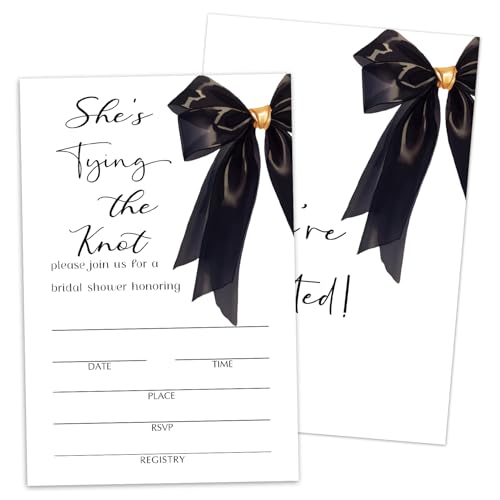
Pack and Size:includes 25 party invitations and quality white envelopes. Invitations are in size 4 x 6 inches and envelopes approximately 5 x 7 inches.
Choose Your Wording Tone: Formal, Casual, or Creative
After establishing the practical details like venue and address, the next consideration involves how you’ll present that information through your invitation’s language and style. Your wording tone sets the overall impression, reflecting your wedding’s personality and formality level.
Formal wording employs full spell-out dates and times, traditional host lines, and complete names, conveying prestige and proper etiquette. This approach suits traditional celebrations and parental hosting arrangements.
Casual wording adopts conversational language with concise phrasing, emphasizing date and time accessibility while simplifying host references. This tone works well for modern couples hosting independently.
Creative wording allows playful, thematic language while maintaining essential details: couple names, date and time, and venue information.
Regardless of chosen tone, ensure your host line, couple names, date and time, and venue details remain crystal clear and consistently formatted throughout your invitation.
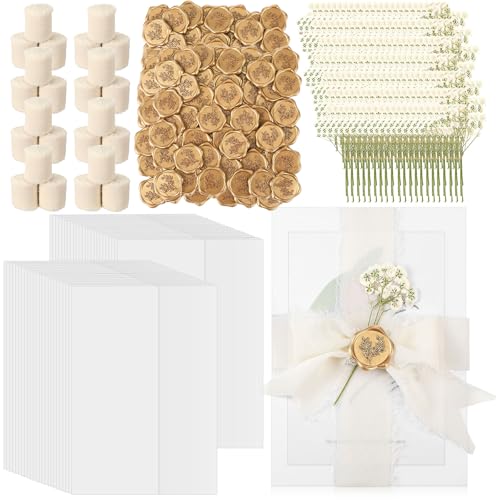
Comprehensive Wedding Package: the wedding invitation accessories include 100 pre folded vellum jackets, 18 rolls of beige chiffon silk ribbons, 100 gold wax seal stickers, and 100 natural dried pressed flowers; It's truly ample for your wedding invitations needs
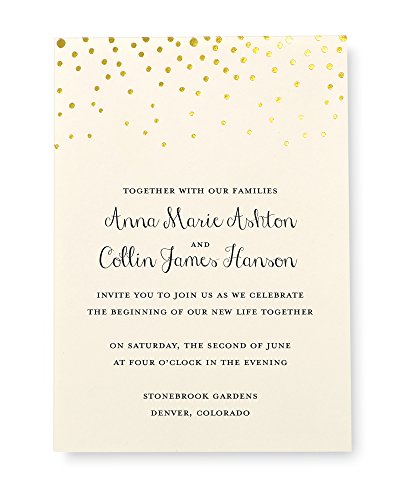
[GOLD FOIL DOT DESIGN] Cascading gold foil dots are stamped directly into smooth ivory cardstock, so the shine is part of the paper rather than printed on top of it
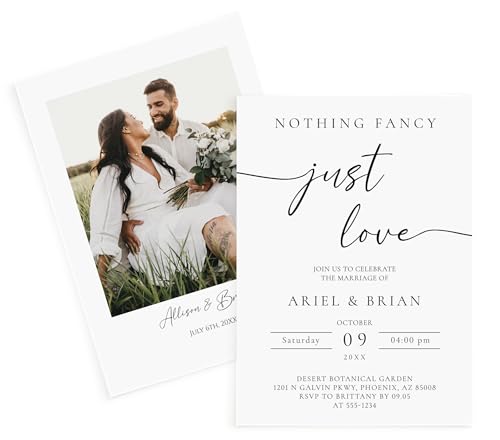
PERSONALIZED INVITES: These pampas grass invitations with envelopes for weddings are the perfect way to get your guests excited about your event! Personalized with your party details. Price shown is the starting price for a set of 25 Invites + 25 envelopes. Additional quantities discounted, options available in customization section. Click the customization button and select the quantity you would like.
Build a Complete Invitation Example
How to transform stylistic choices into a polished invitation requires combining all elements: hosts, couple’s names, full date and time, ceremony venue details, and reception information into one cohesive piece. Wording sets the tone, whether you select “Request the honor of your presence” for formal religious ceremonies or choose casual language for modern celebrations.
| Element | Formal Example | Casual Example |
|---|---|---|
| Host Line | Together with their parents | We’re getting married |
| Couple’s Names | Margaret Elizabeth and James Robert | Maggie and Jim |
| Date/Time | Saturday, the fifteenth of June at four o’clock | June 15th at 4 PM |
| Ceremony Venue | St. Catherine’s Church, 450 Oak Street, Boston, MA 02115 | Riverside Gardens, 450 Oak Street |
| Reception Info | Reception to follow at The Landmark Hotel | Join us for dinner and dancing |
This structure ensures guests receive all necessary information while experiencing your invitation’s personality.

Embossed Gold Foil Stickers: 300 pieces gold stickers for envelopes.

Printed on premium, smooth, heavy cardstock.

● Create Flawless, Professional Cards with Ease - Experience superior quality with our 250 gsm premium cardstock (8" x 6" unfolded); significantly thicker than standard cards to prevent bending and feel luxurious, while the sturdy 120 gsm envelopes ensure your invitations arrive perfectly.
Add Reception Information (or a Details Card)
You’ll need to decide whether your reception happens at the ceremony venue or requires a separate details card to guide guests to a different location. If the reception follows immediately at the same site, a simple line like “Reception to follow” suffices on your main invitation. For receptions elsewhere, create a dedicated insert card listing the venue name, complete street address, city, state, and start time so your guests arrive at the correct destination.

Express Your Gratitude: Your guests will appreciate these exclusive rsvp card invitations to participate in your events and events!

IMPRESS YOUR GUESTS: Your guests are going to love getting invited to send elegant RSVP Response Postcards, that will leave a lasting impression.

This set include 180pcs : 30 pcs 5x7inch wedding invitations, 30pcs 5.3x7.6inch self seal envelopes, 30pcs vellum wraps, 30pcs 5x3.5inch RSVP cards with 30pcs 5.4x3.9inch self seal envelopes and 30pcs pre-made wax seal stickers.
Same Venue Reception Details
When your ceremony and reception happen in the same location, communicate this explicitly while providing guests with the specific details they need. A simple line stating “Reception to follow” works well on your main invitation, or use “Reception to follow at [Venue Name]” for clarity.
For a multi-event day, create a separate details card specifying the reception start time, exact room or hall location, dress code, and any special instructions. Include the full venue address on this insert to maintain consistency throughout your invitation suite.
When space constraints limit your main invitation’s design, a details card or wedding website link preserves readability while delivering essential reception details, amenities information, and logistical guidance your guests need.
Separate Location Logistics
What matters most when your ceremony and reception happen in different places is clear communication that prevents guest confusion and ensures smooth transitions between venues.
Include the full venue names and addresses for both your ceremony location and reception venue details on your invitation or a separate details card. This approach keeps your main invite uncluttered while providing essential information.
Consider using a reception card or insert stating “reception to follow” along with the start time and specific venue information. For multi-venue invitations spanning multiple events, a timeline insert is valuable, listing ceremony, cocktail hour, dinner, and dancing times with corresponding locations.
Verify that all venue names and addresses match official listings exactly. This attention to detail prevents transportation issues and guest frustration while keeping everyone informed throughout your celebration.
Set Your Dress Code Wording
How plainly you communicate your dress code can make the difference between guests arriving perfectly attired and showing up uncertain about what to wear. Clear dress code wording prevents confusion and ensures your wedding invitation etiquette reflects your event’s formality level.
Position your attire guidance at the invitation’s bottom or on a separate insert for legibility. Select specific terminology like Black Tie, Black Tie Optional, Cocktail Attire, Semi-Formal, or Festive Attire rather than vague phrases like “dressy.” Your chosen language should align with your invitation’s overall style and the event’s theme.
Consistent dress code inserts or wedding website details clarify guest attire instructions effectively. Formal invitations warrant traditional wording, while casual celebrations benefit from relaxed language. This thoughtful approach to invitation wording ensures your guests understand expectations and feel confident in their clothing choices.

Quantity: 25 invitation cards with 25 self adhesive white envelopes.

Package including: 25 * Laser Cut Invitations Pockets + 25 * Cream Envelopes+25 * Blank Inner Sheets +25 * Ribbons

[PEARL EMBOSSED BORDER] A single pearl foil border frames each ivory card, creating a framed look that reads formal without competing with your wording
Word Your RSVP Card Clearly
Your RSVP card should plainly specify your deadline (such as “Please respond by July 20, 2028”) and indicate how guests can respond, whether through a printed reply card, website link, or email address. Confirm the exact number of attending guests, meal selections if applicable, and any additional event options like rehearsal dinners or welcome brunches. Consistent tone and phrasing throughout your RSVP section helps guests understand your expectations and enables them to respond with the information you need for proper planning.

Wedding Invitation Accessories: 50 invitation sleeves, 50 blank invitations inner sheets, 50 envelopes, 50 small rsvp cards. as the full set, more convenient and easy to use, and match 2 blank inner sheets, one for invite, one as rsvp card.

Package : 20*Invitations pockets, 20*envelope. 20*Seal (No insert paper)
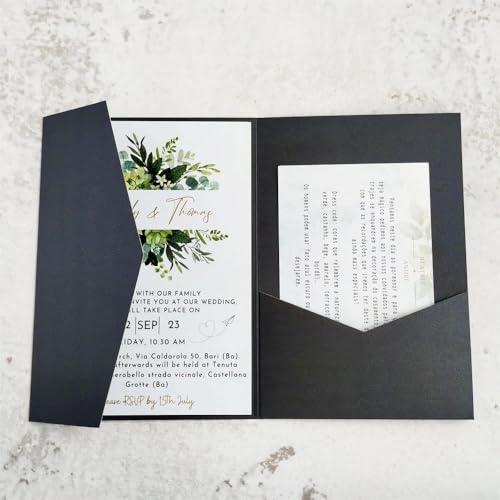
Size: For this tri-fold pocket, the size of the middle part is 5.1 x 7.1 inches. You can glue your 5 x 7 inch invitation to this section. The bottom right-hand pocket is suitable for smaller cards measuring less than 4.5 x 7 inches, such as menus and information cards. Do not try to put a 5 x 7 inch invitation in the right-hand bottom pocket, it will not fit and will curl up. Please check the sizes carefully before placing your order to ensure they are a perfect match.
RSVP Deadline and Format
Perhaps the most critical element of your RSVP card is a distinctly stated deadline, typically four weeks before the wedding date, that eliminates guesswork for your guests. Write the deadline clearly in full dates, such as “Saturday, the Twentieth of June,” to ensure readability and consistency across all invitation materials.
Your RSVP format should accommodate both paper and online responses, recognizing that guests have different preferences. Include a prominent wedding website link on the invitation while maintaining a physical RSVP option for those who prefer traditional paper responses.
Structure your response options to request attendance confirmation, number of attendees, and meal selections where applicable. A discreet reminder on the envelope about deadline compliance reduces late responses and keeps your planning timeline manageable and organized.
Response Method Options
Clear response options form the foundation of effective guest communication, ensuring attendees understand exactly how to confirm their attendance. You should offer multiple response methods to accommodate diverse preferences and accessibility needs. Include a traditional RSVP card with checkboxes for attendance options, guest count, and meal selections clearly labeled. Simultaneously, provide an online RSVP option with your website URL prominently displayed on the invitation itself. This dual-method approach ensures guests without internet access can still respond conveniently through the card. Specify your response deadline explicitly, typically three to four weeks before your wedding date, allowing sufficient time for guest list management and final catering counts. Consistent formatting across all response methods prevents confusion and streamlines your planning process, making attendance tracking straightforward and organized.
Guest Count Confirmation Details
How guests respond to your invitation directly impacts your final headcount and catering arrangements. Your RSVP card should request specific information: the invitee’s name with a clear attendance option, the number of guests in their party, and their meal choices if applicable. Include a response deadline, such as “Response by July 1, 2026,” to facilitate accurate planning. Provide a line asking “Number of guests: ______” rather than leaving it ambiguous. List meal options clearly—Chicken, Beef, Vegetarian—next to each guest name or as a separate field. If you’re using online RSVP amenities, mirror these same fields on your website and reference the link on your physical card. This dual approach ensures guest count confirmation is straightforward and complete.
6 Wording Mistakes Guests Actually Find Confusing
Your wedding invitation carries more weight than you might realize. It’s often the first impression guests have of your celebration, and unclear wording can create confusion that ripples through the planning process. Mixing “the honor of your presence” with “the pleasure of your company” signals conflicting formality levels, leaving guests uncertain about ceremony expectations. An unclear hosting line obscures who’s actually inviting them, creating ambiguity about the event’s significance. Burying your RSVP deadline makes guest count confirmation difficult and complicates logistics. Inconsistent invitation wording, mixing numerals with spelled-out dates and times, disrupts readability and undermines perceived formality. Finally, cramming nonessential details like registry information or extensive itineraries onto the main card overwhelms guests and buries critical event information. Clarity in your hosting line, RSVP deadline placement, and consistent formatting ensures guests understand exactly what to expect.

Elegant White Floral Vellum: Transform your 5x7 invitations with our exquisite white floral printed vellum jackets. The delicate botanical patterns combined with the translucent paper create a timeless, ethereal look that complements any classic or church wedding theme.

Perfect tool for Addressing Envelopes:The Letterings stencil is a clear plastic guide that has perfectly spaced lines to help center your address and keep all letters identical in sizing. Envelope addressing, the letter, wedding invitations, Christmas cards, handwriting designs, etc. You can DIY name, address, Zip Code, greetings.